What Is Agentic AI in HR? 12 Use Cases for Indian HR Teams
Agentic AI in HR is software that plans and completes multi-step HR tasks instead of only answering questions. This guide explains how it works, how it differs from generative AI, 12 use cases in recruitment and HR operations, what Indian and global surveys report, and how to start a pilot.
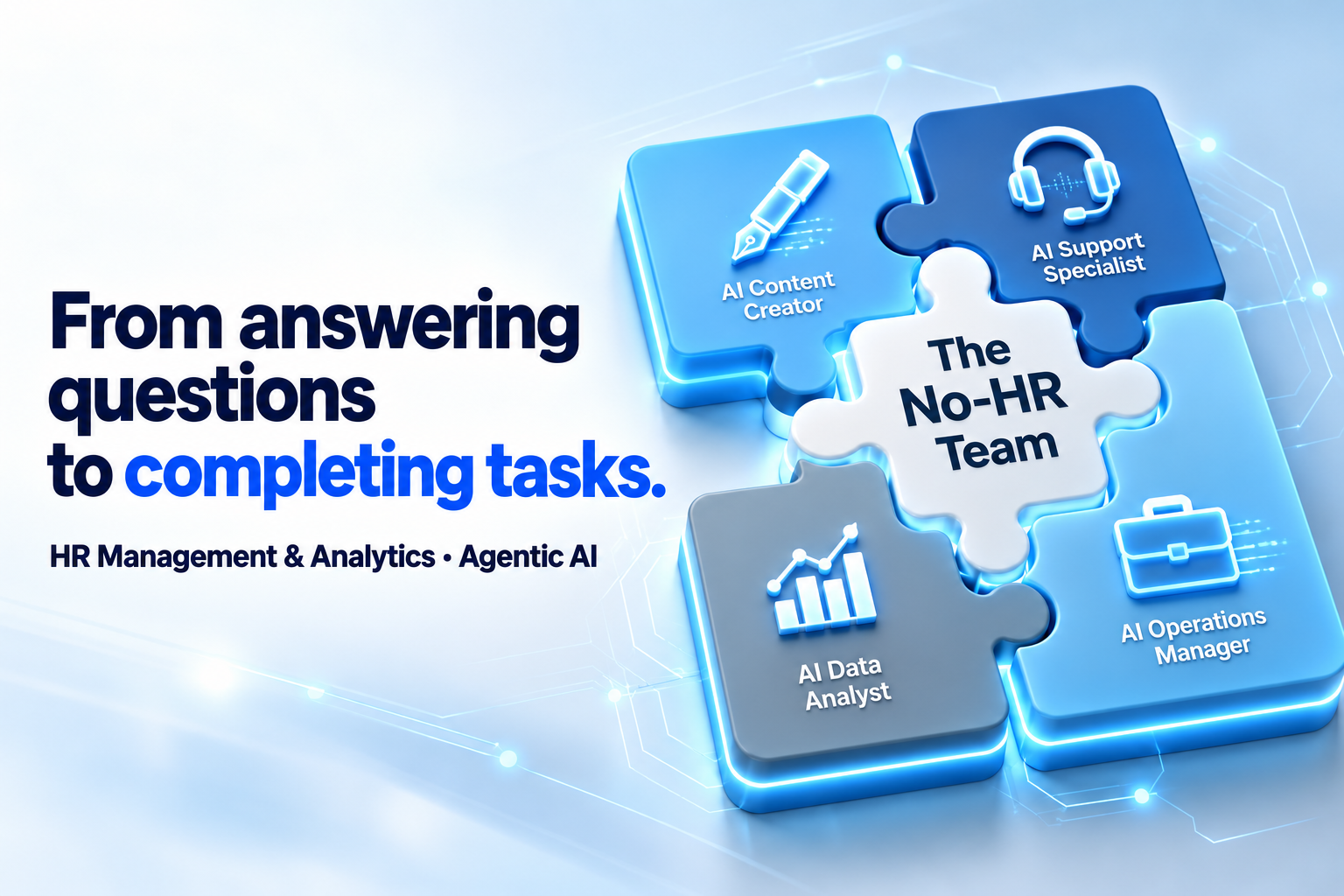
Agents act, not just answer.
12 use cases: 6 in hiring and 6 in HR operations.
12% of surveyed CHROs had fully implemented agents (Salesforce, 2025).
Start with one workflow in read-only mode.
Agentic AI refers to artificial intelligence where the system is assigned a goal and it decides how best to get there. When applied in HR, it means the AI can discover a problem, devise a solution and implement the actions in the tools used by an HR team. Humans are still in control of decisions.
The AI software just executes repetitively. This guide will answer one single question – what can an AI agent really do for an HR team in India? It follows from our explainer HR Management & Analytics and our guide to AI in Recruitment in India. Below we cite several sources that are HR software vendors and label them accordingly.
Agentic AI in HR at a Glance
- What is it? Software that plans and executes multiple steps to accomplish goal-oriented HR tasks, with appropriate human oversight.
- How does it differ from Generative AI? Generative AI creates content based on prompts, while agentic AI can perform actions across connected systems to achieve a defined goal.
- Application areas covered: 12 use cases, with half focused on recruitment and half on wider HR processes.
- Best initial pilot: Run one well-defined workflow, such as onboarding, for 30 days in read-only mode before expanding its permissions.
- Tasks to keep human-led: Final interviews, salary negotiations, compensation changes, and termination decisions.
- Required skills: AI literacy, data literacy, process understanding, and the ability to interpret HR metrics.
Important Terms in One Sentence Each
| Term | Definition |
|---|---|
| Agentic AI | AI that acts to achieve a particular goal through planning and action with only partial step-by-step instructions. |
| AI Agent | One instance of the software that constitutes agentic AI and is tasked with performing particular duties. |
| Generative AI | AI that generates text, graphics, or other content upon receiving prompts. |
| Predictive AI | AI that makes predictions about the probability of an outcome, such as an employee resigning. |
| HRIS | Software that contains employees' files. |
| ATS | Software that handles job advertisements and applicants. |
| Human in the Loop | A design in which a human oversees the steps taken by the agent and either accepts or rejects them. |
| Audit Trail | A log of all the actions taken by an agent. |
01What Is Agentic AI in HR?
Agentic AI in HR refers to software that works towards achieving HR objectives by planning and executing multi-step processes across HR systems, with people overseeing important decisions. Tasks may include scheduling interviews, following up on onboarding documents, and tracking compliance deadlines.
According to HR Cloud, an HR software provider, agentic AI can plan, make decisions, and take actions within connected systems. Taggd, an HR services provider, describes agentic AI as proactive, unlike earlier systems that were primarily reactive. A key characteristic is that an agent can carry out multiple steps without requiring human approval for every individual task, while operating within defined permissions and oversight.
Three characteristics define agentic AI:
- An objective: The agent is given a goal to achieve, such as supporting recruitment or completing onboarding.
- Tasks: The agent performs the required steps in connected systems, such as sending messages, scheduling interviews, or updating information.
- Oversight: People establish boundaries, review the process, and approve important decisions.
02How Is Agentic AI Different from Generative AI and Chatbots?
Generative AI creates content based on a person's input. Agentic AI works towards achieving a goal and can perform actions across connected systems. A chatbot typically answers questions or supports conversations within an application. HR departments may combine these technologies to support different tasks.
The following comparison reflects the context described by Enragedly, an HR software provider, on March 16, 2026.
- Information required: Generative AI typically responds to a prompt. Agentic AI works towards a defined goal and can determine the steps needed to pursue it.
- Initiative: Generative AI generally responds when prompted. Agentic AI can monitor conditions, identify issues, and initiate permitted actions within its instructions.
- Output: Generative AI produces content such as drafts and summaries. Agentic AI can produce content and carry out actions, such as scheduling meetings or sending follow-ups.
- Data used: Generative AI can use information provided in prompts and, when enabled, connected sources. Agentic AI can also use authorised data from systems such as performance, engagement, learning, and payroll platforms.
- Typical HR use: Generative AI can draft job descriptions, feedback summaries, and policies. Agentic AI can support scheduling, follow-ups, monitoring, and alerts.
Predictive AI is a third category. It estimates likely outcomes, such as which employees may be at risk of leaving, but a person or another system generally needs to decide what action to take. An agent can use a prediction as an input for the next step, provided that the action is permitted and appropriately supervised.
03How Does an HR AI Agent Work?
An HR AI agent follows a four-step loop: identifying a situation, planning the next actions, acting across connected systems, and monitoring whether the outcome improves. People define the boundaries and permissions for the agent, including which actions require their approval.
According to HR Cloud, the process can be understood through these four steps:
- Identify: Detect a problem, request, or potential risk using available information.
- Plan: Determine the appropriate next steps based on the goal, available data, and defined rules.
- Act: Carry out permitted tasks, such as sending messages, scheduling meetings, or updating records.
- Monitor: Check the results to determine whether the situation has improved or further action is needed.
Sensitive actions require appropriate human review and approval before the agent proceeds.
Consider an example involving employee attrition. An HR AI agent may flag a potential retention concern using authorised engagement and attendance data. It can then suggest next steps, such as sending a check-in message or scheduling a meeting with a manager. The agent monitors available indicators to assess whether engagement improves. Sensitive decisions, such as changing an employee's pay, must remain subject to appropriate human approval.
04Which Recruitment Tasks Can an AI Agent Handle?
An AI agent can support six recruitment tasks: candidate sourcing and screening, candidate outreach, interview scheduling, first-round screening, shortlisting, and pipeline reporting. Taggd identifies seven recruitment steps, which this guide groups into six use cases by combining sourcing and screening.
The six recruitment use cases are:
- Use case 1: Candidate sourcing and screening. The agent searches candidate databases and professional networks on an ongoing basis and checks candidate claims against available information.
- Use case 2: Candidate outreach. The agent sends personalised messages and follow-ups, referring complex cases to a recruiter when human intervention is needed.
- Use case 3: Interview scheduling. The agent matches availability, books interview slots, sends confirmations, manages rescheduling, and updates the applicant tracking system (ATS).
- Use case 4: First-round screening. The agent can conduct a structured voice interview and provide the recruiter with a summary for review.
- Use case 5: Shortlisting. The agent prepares a shortlist and provides explanations for its rankings, allowing recruiters to review the recommendations and check for potential bias.
- Use case 6: Pipeline analysis. The agent identifies candidate drop-off points, analyses recruitment channel performance, and highlights patterns that may support workforce planning.
Taggd emphasises that final-round interviews and offer negotiations should be handled by people. It also highlights the importance of informing candidates at the beginning of the process when they are interacting with an AI recruiter. Human recruiters should retain oversight of important hiring decisions, and AI-assisted screening should be reviewed for fairness and accuracy.
Learn more about AI tools and their advantages to understand where they can support your recruitment process.
05Which Other HR Tasks Can an AI Agent Handle?
The other six HR operations functions that an AI agent will be able to manage include onboarding coordination, resolution of employee queries, compliance management, performance and goals nudges, engagement monitoring, and learning and talent review recommendations.
There are six HR operations use cases:
- Use case 7: Onboarding coordination (source: HR Cloud). The agent provides pre-boarding documents, manages follow-ups on missing items, and triggers IT provisioning and orientation.
- Use case 8: Employee query resolution (source: HR Cloud). The agent reviews the employee's leave balance, submits the request, and routes it to the manager.
- Use case 9: Compliance management (source: HR Cloud). The agent monitors licence expirations, submission deadlines, and training completion, and escalates them when required.
- Use case 10: Performance and goals nudges (sources: Enragedly and HR Cloud). The agent flags teams that are falling behind on their goals and prompts managers to follow up.
- Use case 11: Engagement monitoring (source: Enragedly). The agent applies sentiment analysis to detect declining team engagement and alerts managers.
- Use case 12: Learning and talent review (source: Enragedly). The agent suggests learning paths and mentors, identifies skill shortages, and highlights employees with high potential.
Sources such as HR software vendors describe features their products offer; these descriptions should not be treated as independent research findings. Verify each capability with vendors during a pilot in your organisation. AI agents also require reliable data. Therefore, establishing the 15 core HR metrics and their definitions is an important starting point.
BUILD THE HR ANALYTICS AND AI SKILLS BEHIND AGENTS
The Professional Certificate in HR Management & Analytics Using AI by eAsia Academy teaches HR professionals to work with workforce data and AI tools.
06Where Does India Stand on Agentic AI in HR?
Adoption of agentic AI in HR is still at an early stage. Salesforce's survey of 200 HR executives reported that 12% had fully implemented agentic AI and projected adoption to reach 58% by 2027. EY found that 24% of Indian leaders were already deploying agentic AI across functions, as cited by Taggd.
- HR leaders: Salesforce, in collaboration with NewtonX, surveyed 200 HR executives worldwide, including 41 in India, and published the results on May 27, 2025. The study reported that 12% had fully implemented agentic AI and projected adoption to reach 58% by 2027, representing a reported rise of 383%. It also reported that 85% of Indian CHROs expected humans and AI agents to work together across most workforces within five years. The study does not provide India-specific results for every reported figure.
- Skills: In the same Salesforce research, CHROs rated AI literacy as the most important skill workers would need. Additionally, 88% reported that they were reskilling or planning to reskill their workers.
- Indian organisations: Taggd cites Deloitte's *State of AI in the Enterprise (2026)*, reporting that 40% of Indian organisations were at advanced stages of AI implementation. It also cites EY's *AIdea of India: Outlook (2026)*, which states that 24% of Indian organisations had implemented agentic AI solutions. These are secondary references, so the original reports should be checked for definitions, methodology, and further details.
- Project outcomes: Gartner predicted that more than 40% of agentic AI projects would be cancelled by the end of 2027 because of unclear business value and inadequate governance. This prediction was reported by Outlook Business.
Salesforce's findings date back to 2025, so organisations should look for more recent surveys before using these figures in a business case. The reported findings suggest that adoption, workforce readiness, and governance all need careful consideration. The evidence cited here does not establish that every HR team is still at the pilot stage.
"Most HR teams are still at the pilot stage, which makes a careful first workflow the best starting point."
07How Should an HR Team Start with Agentic AI?
Before adopting Agentic AI, an HR team should follow six practical steps to prepare its workflows, data, approval processes, and performance measurement.
01. Audit Three Workflows
Identify the three HR workflows that consume the most hours and list all their manual steps.
02. Clean the Data
Correct duplicate entries, missing fields, and inconsistent formats before automating HR processes.
03. Pilot in Read-Only Mode
Start with one workflow, such as onboarding. Let the agent make recommendations while people make decisions, and measure accuracy for 30 days.
04. Set Autonomy Limits
Clearly define which actions the agent can perform independently and which require human intervention.
05. Expand Gradually
Once the pilot demonstrates reliable accuracy, grant appropriate execution rights and move to the next workflow.
06. Review Metrics and Audit Trails
Review the agent's actions and track HR performance metrics, including time to hire.
How Much Should an HR Agent Be Allowed to Do Alone?
HR Cloud recommends starting in read-only mode, where the agent suggests actions and a person approves them. Autonomy can then increase as accuracy improves. The following three levels are a planning framework, not a formal standard.
Recommend Only
The agent suggests an action. A person decides whether to accept and perform it.
Perform with Approval
The agent prepares an action but waits for human approval before executing it.
Perform Independently
The agent handles routine actions within defined boundaries and records what it does.
Keep High-Impact HR Decisions Under Human Control
Compensation changes, disciplinary actions, and terminations should remain at Level 1 or Level 2, according to HR Cloud.
Taggd notes that employers remain the data fiduciary under India's Digital Personal Data Protection Rules, 2025, even when a vendor processes the data. Taggd reports that the Rules were notified on November 13, 2025, with full compliance required by May 13, 2027. Confirm the applicable dates and obligations with your legal team. Taggd also expects shortlist quality to improve over two to three hiring cycles rather than overnight.
Track results using the same metrics each quarter. Our guide to 15 HR Metrics Every HR Manager Should Track explains how to compare time to hire, cost per hire, and offer acceptance rate before and after a pilot.
08What Skills Do HR Professionals Need for Agentic AI?
HR professionals need five skills for agentic AI: AI literacy, data literacy, process mapping, HR metrics, and governance. Salesforce's survey ranks AI literacy as the top skill CHROs expect workers to need.
01. AI Literacy
Understand what an AI agent can and cannot do, and how to define a clear goal for it.
02. Data Literacy
Read, clean, and question HR data, because agents act on the data they are given.
03. Process Mapping
Break HR workflows into clear steps that can be assigned to a person or an AI agent.
04. HR Metrics
Measure an agent's impact using defined metrics such as attrition rate and time to hire.
05. Governance
Set approval limits, maintain audit trails, and document who is responsible for each decision.
These skills build on core HR analytics. The Professional Certificate in HR Management & Analytics Using AI at eAsia Academy teaches HR professionals to work with workforce data and AI tools, with live weekend classes.
09Where Can You Learn More?
- What Is HR Management & Analytics (HRMA)?: The foundation for agent-led HR.
- AI in Recruitment in India: Tools and Benefits: The hiring side of agentic AI.
- HR Metrics Every HR Manager Should Track: The numbers that show whether an agent works.
- What Is ESG? Meaning, Pillars and Reporting in India: Where workforce data appears in sustainability reports.
- GRI Standards Explained: The reporting framework that includes employee data.
- Carbon Credits: What They Are and How They Work: A fast-growing field for career switchers.
- What Is India's Carbon Credit Trading Scheme (CCTS)?: India's compliance carbon market.
- Scope 1, 2 and 3 Emissions Explained: The foundation of carbon accounting.
- What Is a Carbon Footprint and How to Calculate It in India: A worked calculation.
- Carbon Credit Certification for HVAC Professionals: An example of a sector-specific certificate.
- IIT Roorkee Certification in Carbon Credits: Is It Worth It?: How to evaluate a certification.
For structured learning, explore the HR Management & Analytics program, the Carbon Credits, Carbon Markets & Net-Zero Pathways program, our guide to the best carbon credit course in India, or browse all eAsia Academy blogs
FAQs
10Agentic AI in HR refers to software that works towards HR-related goals by planning and performing multi-step actions across connected HR systems. Examples include scheduling interviews, following up on onboarding documents, and monitoring compliance deadlines, while people retain oversight of critical decisions.
Generative AI creates content in response to user prompts, such as drafting job descriptions or summarising feedback. Agentic AI works towards a defined goal and can perform actions across connected systems, such as scheduling interviews and updating applicant tracking systems. HR teams can use both technologies together.
Examples include candidate sourcing and screening, candidate outreach, interview scheduling, initial voice screening, shortlisting, recruitment pipeline analysis, onboarding coordination, employee query resolution, compliance monitoring, performance and goals reminders, engagement monitoring, and learning and talent recommendations. This guide covers 12 use cases across recruitment and HR operations.
Agentic AI can automate routine tasks and support HR workflows, but people should retain oversight of important decisions. HR professionals remain responsible for areas such as final-round interviews, offer negotiations, compensation changes, disciplinary actions, and terminations. Appropriate human review and governance are essential.
An HR team can start by auditing its three most time-consuming workflows, cleaning its data, and piloting one workflow in read-only mode for 30 days. The team should define autonomy limits, review accuracy and audit trails, and gradually expand the agent's permissions based on measured results. Legal and data protection requirements should also be reviewed.